
Enterprise network management is the ongoing process of keeping a business network reliable, secure, visible, and ready for change. In a small environment, that work can stay simple for a long time. In an enterprise environment, the network quickly becomes a living system with many moving parts. Branch offices, cloud applications, wireless density, remote access, guest traffic, security controls, voice services, cameras, and connected devices all place demands on the same infrastructure.
That complexity is what turns network management into an operational discipline. The network has to support daily business activity without forcing the IT team into a permanent cycle of workarounds. Performance has to stay stable during growth. Configuration changes have to be controlled. Security has to remain aligned with how traffic actually moves. Monitoring has to produce useful signals instead of noise. Good enterprise network management creates that structure and keeps it intact as the environment evolves.
Enterprise network management covers the technologies that move traffic and the practices that keep them working together. That includes switching, routing, wireless, WAN connectivity, internet circuits, VPN services, firewall policy, segmentation, monitoring, alerting, firmware planning, documentation, and lifecycle management.
It also includes the relationships between those layers. A user may report slow application access, yet the source of the problem may sit in uplink congestion, path selection, a misaligned firewall rule, poor roaming design, or a branch circuit under strain. Enterprise environments rarely fail in a neat, isolated way. Problems tend to cross layers, which is why strong management depends on a complete operating view.
In advanced network management, the network is considered a single, integrated system. Traffic flow, access control, resilience, and visibility are reviewed together. Site standards are defined clearly. Configuration authority is controlled. Support teams know how changes are approved, how issues are escalated, and what “normal” looks like from one location to the next.
Visibility is the base requirement for enterprise network management. No team can manage a network well if the environment is only partially documented and monitored. Current inventory, topology maps, addressing plans, VLAN structure, SSID design, circuit details, uplink roles, and firmware status should all be known and maintained. When those records are outdated, even routine tasks become slower and riskier.
Monitoring has to do more than confirm that devices are online. It should show the conditions that affect service quality in real time and over time. That usually includes:
The value comes from context. A busy branch, a headquarters floor, a warehouse, and a retail location will never produce the same traffic profile. Baselines need to reflect that. A network management platform that triggers the same thresholds everywhere will create alert fatigue in one place and miss early warning signs in another.
Cloud-managed infrastructure can improve this aspect of the job by centralizing visibility across sites. In Cisco Meraki environments, teams can review alerts, configuration state, client behavior, and device health from one management plane. That can make large environments easier to govern, though the platform only helps when the underlying standards are consistent, and the team uses the data actively.
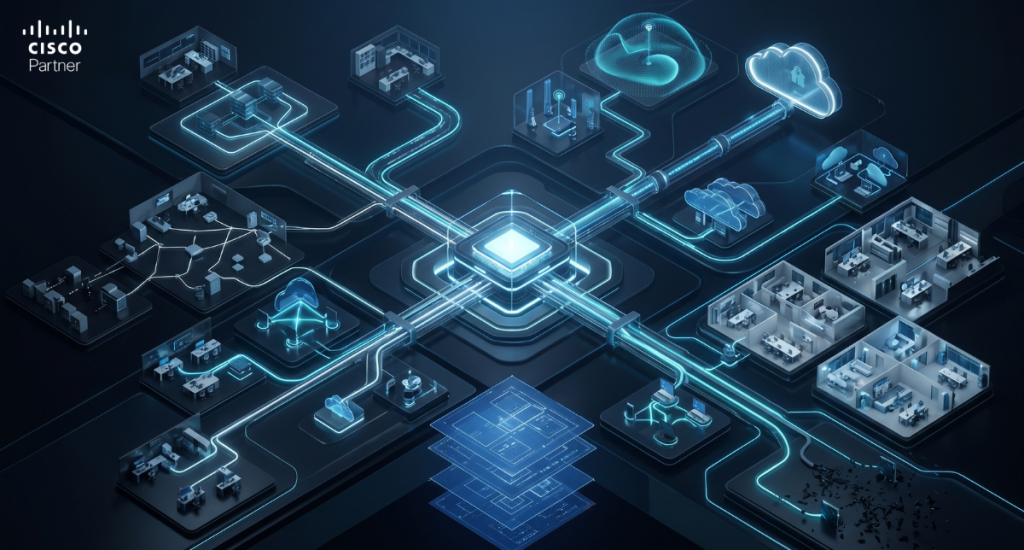
Large networks become difficult to support when each site drifts in its own direction. One location uses a different naming structure. Another has custom VLANs that no longer match the standard. A wireless rollout was done quickly and never normalized. A branch firewall contains exceptions added for a temporary need years ago. Over time, the network becomes harder to read and harder to trust.
Standardization reduces that friction. It creates repeatable patterns for switching, wireless, WAN policy, firewall roles, IP addressing, device naming, firmware planning, and support procedures. Those patterns do not eliminate local flexibility. They create a stable foundation so local needs do not turn into long-term disorder.
This has a direct effect on daily work. Troubleshooting moves faster because each site is easier to compare with the others. New staff members learn the environment more quickly. Branch deployments follow a cleaner path. Procurement stays more predictable because the hardware, licensing, and operational model are already defined.
Documentation belongs in the same category. Diagrams, IP plans, support notes, and policy maps need to reflect the real network, not the network as it existed two years ago. Good documentation shortens incident response and reduces the chance of a failed change during a maintenance window.
Enterprise network performance is rarely a single-device story. Users experience the network through call quality, roaming, application response, video sessions, file transfers, VPN stability, and access to shared services. A switch can be healthy while the user experience is poor. That is why enterprise network management needs to follow the full path a service takes through the environment.
On the wired side, common sources of degradation include oversubscribed uplinks, limited switching capacity, poor traffic distribution, and pathing decisions that made sense before the business grew. A network that performed well in an earlier phase may now be carrying more cloud traffic, more east-west traffic, more real-time collaboration, and more connected devices than the original design expected.
Wireless performance needs the same level of scrutiny. Access point count tells only a small part of the story. Coverage, channel planning, roaming behavior, client density, RF interference, and building materials all influence results. High-density meeting areas, mixed-use floors, healthcare spaces, schools, warehouses, and public-facing sites all present different wireless conditions. Wireless network management has to account for those differences and review them regularly.
WAN performance adds another layer. Branch offices, cloud applications, remote access, and interoffice traffic all depend on stable path selection and sensible policy. If internet breakout, failover behavior, and application treatment vary from site to site, performance complaints start to look random. In reality, they usually reflect inconsistent policy or weak operational control.
SD-WAN has become important for this reason. It can improve path selection, failover logic, and policy consistency across sites. Used well, it gives the network team stronger control over application behavior and branch resilience. Used carelessly, it can spread bad policy more quickly than older WAN models. The benefit comes from disciplined design and disciplined management.
Many enterprise network issues begin with a change that looked harmless at the time. A VLAN is extended for a new device group. A firewall rule is added to speed up a rollout. A switch template is adjusted to solve a local issue. A wireless setting is changed during troubleshooting and never restored. None of those actions seems major in isolation. Taken together, they create drift.
Configuration management is the discipline that keeps drift under control. It starts with ownership. Teams need to know who can make changes, which changes require review, how changes are documented, and how current configurations are stored and compared. Without that discipline, the network starts to move away from its standard.
Version awareness matters here as well. Firmware changes, feature behavior, and platform dependencies can alter how the same configuration behaves across different sites or device generations. Configuration backups, change logs, and periodic config reviews reduce that risk. They also make rollback more practical when a planned update causes instability.
In cloud-managed networks, configuration management can be easier to enforce because templates and centralized controls help keep the estate aligned. That does not remove the need for process. It makes the process easier to apply across many locations.
Network security works best when it stays tied to day-to-day management. If it is treated as a separate concern that comes up only during audits, renewals, or major incidents, the environment tends to drift. Temporary exceptions remain in place. New device classes appear without a clear segment. Guest access expands. Branch workarounds become permanent. The policy model becomes harder to explain and harder to defend.
Segmentation remains one of the clearest tools for controlling that drift. Corporate devices, guest traffic, printers, cameras, voice systems, building controls, IoT devices, and sensitive internal services should not all exist in the same trust zone. Clear separation limits exposure, simplifies policy enforcement, and improves troubleshooting because traffic boundaries are easier to trace.
Firewall policy requires the same discipline. Rule sets tend to grow unevenly over time. Old entries remain after the original project ends. Quick fixes become permanent logic. Duplicate rules accumulate. A well-developed network management program consistently revisits its policies, purges outdated information, and confirms that enforcement practices match the current network configuration.
Visibility supports security in practical ways. Repeated authentication failures, unusual traffic patterns, unexpected inter-VLAN behavior, and administrative changes should be visible early. Good monitoring helps the team catch drift before it becomes a service issue or a security incident.
Every enterprise network needs a clear method for detecting, isolating, and resolving faults. In weak environments, fault handling starts from scratch every time. The team gathers fragments of data, guesses where to begin, and relies too heavily on individual memory. In stronger environments, fault management is structured. Baselines exist. Escalation paths are known. Documentation is current. Device health, circuit state, recent configuration changes, and client impact can be reviewed in a single flow.
That structure changes how quickly service can be restored. A branch outage is easier to diagnose when the team can see the status of the WAN links, VPN state, recent policy changes, and access switch health in one place. A wireless complaint is easier to narrow down when roaming behavior, client density, AP health, and recent RF changes are already visible.
Fault management also benefits from pattern review. Recurring issues at the same site, repeated circuit instability, frequent AP overload in one area, or the same class of config error appearing across branches all point to a structural problem. If the team only fixes the immediate symptom, the network stays fragile.
A large share of avoidable network disruption comes from planned work. Firmware upgrades, SSID edits, VLAN changes, ISP replacements, firewall updates, and hardware swaps can all trigger wider impact if they are rushed or poorly staged. Enterprise network management needs change control that is practical, repeatable, and tied to real business activity.
Good change control starts with scope. The team should know which services are affected, what dependencies might surface, how success will be validated, and what rollback path is available if the change does not behave as expected. That level of discipline matters even for familiar tasks because environments drift over time and the same change can produce different results in different conditions.
Maintenance windows also need business context. A quiet hour for one department may still affect remote access, transaction systems, healthcare workflows, or overnight operations elsewhere in the organization. Change planning has to reflect how the business actually uses the network.
Strong change control reduces failed work, shortens recovery time, and limits the spread of local mistakes. It also improves trust in the network team because planned work becomes more predictable.

Enterprise networks rarely break all at once. More often, they lose margin slowly. Wireless density increases. WAN usage grows. Older switches stay in production because they still function. Firmware options narrow. A branch keeps adding devices to a design that was sized for a smaller footprint. Capacity and lifecycle planning prevent those slow declines from turning into urgent problems.
Capacity planning should review uplink usage, circuit trends, client growth, site expansion, rack and power limits, switching demand, and service behavior across time. This should happen regularly, not only after users begin reporting issues. The earlier growth patterns are identified, the more options the team has for a clean upgrade path.
Lifecycle planning belongs in the same process. Device age, support status, firmware compatibility, licensing dates, and replacement windows all shape how manageable the environment remains. Hardware does not need to fail outright to become a risk. Once support options tighten, every major change becomes harder to stage safely.
Cisco Meraki environments can simplify parts of lifecycle oversight because licensing, inventory, and device state are easier to review centrally. That visibility helps teams plan replacements and updates across distributed sites with less guesswork.
Enterprise network management depends on the people running it as much as the technology stack itself. Some organizations have an internal network team with clear specialization. Others rely on a lean IT group that handles networking, endpoints, SaaS administration, security tasks, and user support. Those two environments need different operating models.
In many cases, the most practical model combines internal control with outside support. Internal teams keep ownership of priorities, site coordination, and change approvals. External specialists support monitoring, maintenance planning, troubleshooting, architecture reviews, and larger upgrades. That arrangement can work especially well in cloud-managed environments because shared visibility makes collaboration easier.
The main requirement is clarity. The team needs defined ownership, clear standards, clean escalation paths, and enough operational depth to keep the environment from slipping into exception-based management.
A well-managed enterprise network is easier to operate because the environment stays coherent as it grows. Site standards remain consistent. Performance issues are easier to isolate. Security controls stay aligned with actual traffic patterns and access needs. Change windows carry less risk because the network is documented, monitored, and maintained with discipline.
That result does not come from one dashboard or one product family. It comes from a management model that keeps visibility, performance, configuration control, security, fault handling, and lifecycle planning working together. In enterprise environments, that consistency has a direct effect on uptime, service quality, and how smoothly the network can support the next stage of growth.For organizations reviewing their current environment, Stratus Information Systems can help with network design, network management, wireless spectrum analysis, Cisco Meraki solutions, and broader infrastructure planning.