Network management services keep a business network stable after deployment. They cover the ongoing technical work required to monitor performance, maintain configurations, respond to faults, protect security, and support growth across the environment. In practical terms, the service keeps the network usable as daily business conditions change.
That distinction matters because a production network is never static. New devices appear, traffic patterns shift, software changes, bandwidth demand grows, and security requirements tighten over time. A network that worked well at launch can become harder to manage a year later if nobody is actively maintaining it. Network management services exist to prevent that drift from turning into recurring outages, poor user experience, or avoidable support burden.
Most networking projects focus on design, installation, and cutover. Those phases matter, though they are only the beginning. Once the hardware is installed and the sites are online, the real operational work begins. Someone still needs to review alerts, tune performance, keep firmware up to date, investigate faults, track changes, and ensure the environment continues to match how the business actually operates.
That is where network management becomes valuable. It gives the network a steady operating layer instead of leaving it in a largely reactive state. Without that layer, support tends to follow a familiar pattern. Users report an issue, someone fixes the immediate symptom, and the environment moves on until the next incident. A managed approach works differently. It aims to reduce recurring issues, shorten the time to resolution, and keep the network in a healthier condition between incidents.
This is one of the main differences between a network that looks good on a diagram and a network that performs consistently in real life.
A good service model covers more than one type of task. It combines monitoring, maintenance, troubleshooting, change control, security review, and operational reporting into one ongoing service.
Network monitoring is usually the most visible part. That includes watching the health of firewalls, switches, access points, uplinks, VPNs, wireless service, and connected sites. Monitoring helps surface degraded performance, unstable circuits, device failures, and unusual behavior early enough for the support team to act before the problem spreads further.
Network maintenance is the quieter side of the service, though it often has the biggest effect on long-term stability. Firmware planning, configuration cleanup, policy review, wireless network performance optimization, switch port management, and routine health checks all fall into this category. These tasks are easy to delay when a team is busy. Over time, delayed maintenance usually turns into avoidable complexity.
Troubleshooting is the incident-response side. When a branch loses connectivity, a site-to-site VPN becomes unreliable, an access point starts dropping users, or a switch port stops behaving normally, the service team isolates the root cause and works the issue toward resolution. That can include remote diagnostics, local task guidance, ISP coordination, or vendor escalation.
Change control is another important piece. Networks rarely fail because of a single dramatic error. More often, they become unstable after many ordinary changes made over time. A new VLAN is added, a firewall rule is updated, a wireless policy is adjusted, and a branch receives a second circuit. Each change may make sense on its own. Without discipline around those changes, the environment becomes harder to support and harder to troubleshoot.
Security oversight belongs inside the same service. Firewall policies, segmentation, wireless access controls, administrative permissions, remote access settings, and firmware posture all need regular review. Security is part of network operations, not a separate subject that only appears during audits or emergency projects.
Reporting gives the business a clear picture of what is happening. A strong provider should be able to explain site health, recurring issues, major changes, trends, and risks in plain terms. The value is not in sending a list of alerts. The value is in helping the client see what deserves attention and why.
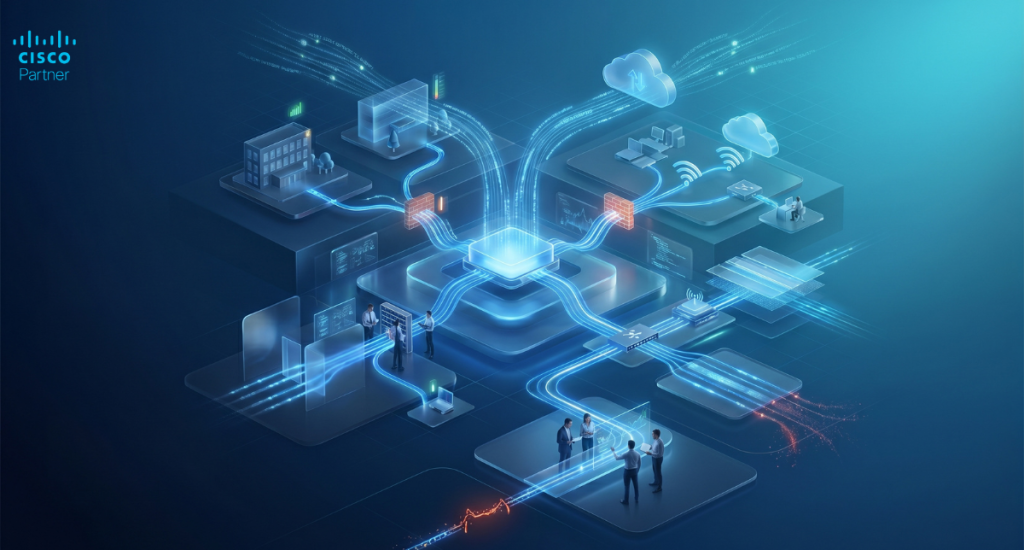
Many businesses assume a network is being managed if someone is watching a dashboard. That is too narrow. Monitoring is a tool, not the service itself.
A screen full of alerts does not decide what matters most, what can wait until tomorrow, or what points to a deeper design problem. The provider still needs to interpret conditions correctly and take action at the right level. One branch may show repeated uplink loss because the carrier circuit is unstable. Another may show the same symptom because a local firewall uplink is failing. In both cases, the alert is only the start.
This is why managed network services are more valuable than simple alert forwarding. The provider should know the environment well enough to recognize patterns, identify root causes, and handle the issue in a way that reduces future disruption. Good service is not built on collecting notifications. It is built on making the network easier to operate over time.
Break-fix support begins after something has already gone wrong. A site goes down, users lose access, a ticket is opened, and someone starts investigating. That model can restore service, though it does little to improve the network between incidents.
Managed network services follow a different model. The provider remains involved before, during, and after faults. The work includes ongoing review, early detection, preventive maintenance, and corrective action tied to longer-term stability. Instead of treating every issue as a standalone event, the service looks at what keeps repeating and why.
That difference matters for businesses with several sites or limited internal networking resources. A reactive-only model often results in the same class of problem appearing again and again. A managed model is designed to reduce that repetition. It creates continuity, not just support tickets.
In a healthy managed environment, many of the most important actions happen before the client notices anything unusual. A provider may review WAN stability at one branch, validate wireless performance at another, clean up stale configurations, adjust alert thresholds, review failed authentication patterns, or confirm that firmware scheduling is still aligned with operational needs.
Some of that work is visible to the client. Incident updates, change requests, outage response, and service recommendations are obvious examples. Other parts are less visible, though still important. Reviewing client behavior, tracking recurring trouble spots, confirming that configuration changes were applied cleanly, and preparing for hardware lifecycle decisions all contribute to a stronger network.
This is also where operational familiarity becomes valuable. A team that already manages the environment can respond faster during incidents because it already knows the site layout, the recent changes, the recurring trouble spots, and the normal traffic behavior. That context often shortens fault isolation and reduces unnecessary escalation.
A business network can be online and still be poorly protected. Stability and security are related, though they are not the same thing. A mature service needs to pay attention to both.
In practical terms, that means regular review of access controls, wireless security, firewall policy, VPN settings, segmentation, dashboard permissions, and the overall condition of the environment. A stale rule or weak administrative control may not cause an outage today, though it can still create risk that grows quietly over time.
This is especially important in cloud-managed environments built on Cisco Meraki. A central dashboard makes support faster and more scalable. It also means one administrative mistake can affect several sites or device categories at once. That makes disciplined access control and policy review part of normal operational care.
Cloud-managed networking has improved the way network management services are delivered. Platforms such as Cisco Meraki give providers centralized visibility into switches, wireless networks, security appliances, cameras, gateways, and sensors across multiple locations. That allows the support team to review site health, investigate problems, apply changes, and verify outcomes without depending on constant onsite presence.
This is a major advantage for businesses with distributed locations. It reduces the delay between detection and action. It also improves consistency because the team can work from one management plane instead of several disconnected tools.
The platform still does not replace technical judgment. It makes good judgment more effective. A provider with strong expertise can move faster, support more locations, and maintain better operational standards when the environment is visible from one place.
Network management services are useful anywhere the network carries real business weight and internal support time is limited. That includes retailers, schools, healthcare groups, branch-based businesses, warehouses, professional offices, and growing companies with more than one site.
These organizations often depend on the network for much more than internet access. Payment systems, voice traffic, cloud platforms, wireless access, building systems, security devices, and remote users all rely on stable connectivity. Even a short outage can interrupt revenue, delay work, or create service problems for staff and customers.
Internal IT teams benefit as well. A managed service does not always replace in-house expertise. In many cases, it supports that team by taking ownership of ongoing network-focused work such as monitoring, maintenance, escalation, and issue coordination. That leaves internal staff more time for user systems, application support, project work, and planning.
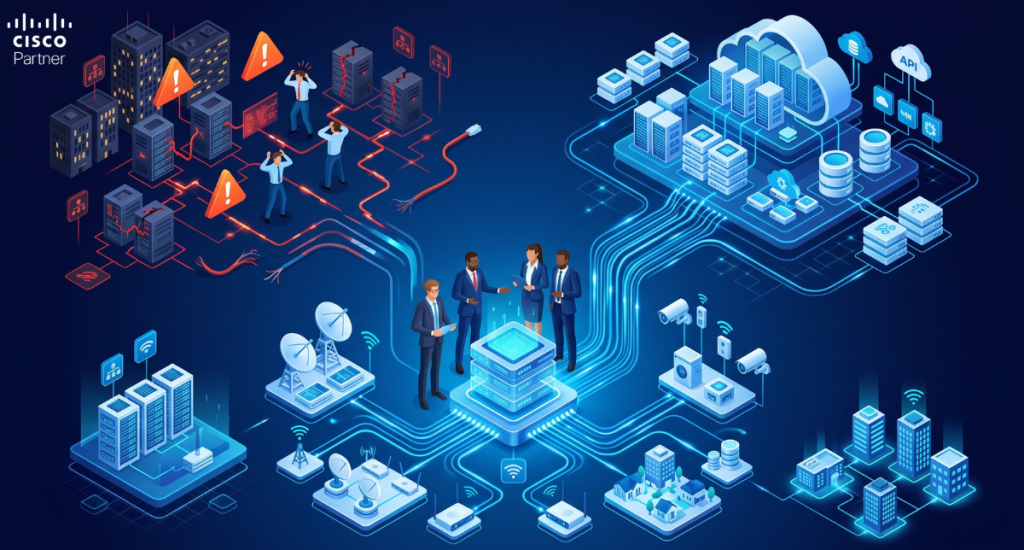
A strong provider should bring more than a monitoring platform and a help desk queue. Technical depth matters first. The team should be comfortable with switching, wireless, firewalls, WAN behavior, VPN design, cloud-managed operations, and security controls.
Operational discipline matters just as much. The provider should have a clear way to handle alerts, maintenance, changes, incidents, reporting, and escalation. If the service depends on ad hoc effort, the quality will eventually become inconsistent.
Communication is another major factor. Clients should know what the provider is watching, how issues are handled, what changes are recommended, and what deserves attention next. A managed service should reduce uncertainty around the network, not add more of it.
The last factor is fit. Some organizations want a provider to take broad ownership of the environment. Others want a partner that works alongside internal IT. Both models can work, as long as the responsibilities are clear and the provider can adapt to the way the business operates.
Cisco Meraki networks are well-suited to a managed service model because the Dashboard provides centralized visibility and control across distributed infrastructure. That makes it easier to support several branches, coordinate changes, review wireless conditions, monitor uplinks, and manage security settings from one place.
For businesses already using Meraki, the practical value is straightforward. A capable provider can do more remotely, respond faster, and keep the environment more consistent across locations. That is especially useful for organizations that depend on several Meraki product categories at once, such as switching, wireless, security appliances, cameras, gateways, and sensors.
For businesses planning a Meraki deployment, the same logic applies. The platform supports efficient management, though it still benefits from a service model that gives the environment steady operational ownership after installation.
Network management services are the ongoing operational layer that keeps a business network reliable after the deployment is finished. They combine monitoring, network maintenance, troubleshooting, change control, security oversight, and reporting into one service model that supports uptime and long-term stability.For organizations that depend on Cisco Meraki and need a more scalable support model, this kind of service can reduce support burden, improve visibility, and keep the environment aligned with business needs over time. Stratus Information Systems provides this support through practical expertise, cloud-managed operational discipline, and a service approach built around keeping live environments stable.