Your business is scaling, and you need a network that can keep up with growing demands. You need a strong foundation on which to build new technologies to meet future business needs. You also need to cut the complexity and stop spending so much time troubleshooting. The time has come. This article provides a feature comparison between Meraki and Aruba switches, focusing on their suitability for enterprise networks that require advanced routing, switching, security, and high availability.
A smart, fast way to build and manage your new or broadening networks starts with switches—but which should you choose?
Our experts at Stratus Information Systems have put together this meraki vs Aruba switch comparison guide so you, as the captain of your IT enterprise, can deftly navigate your infinitely-expanding environment.
Finding the right network products for your business’s situation and budget can be challenging, but don’t settle—you must provide a robust and reliable connection. For growing enterprises, selecting a cost-effective solution that supports scalable networks is essential to ensure your infrastructure can adapt as your organization expands.
You’re fully capable of making the right choice between Aruba vs. Meraki switches, but we’re here to help cut out some of the time it takes to do the necessary research. Both platforms enable organizations to manage security policies centrally and maintain strong network security, which is critical for protecting sensitive data and ensuring compliance. Simply use this Aruba vs. Meraki comparison guide and confidently issue the command.
When planning network deployments, keep in mind that both Meraki and Aruba require careful consideration of their pricing structures and long-term costs to ensure the best fit for your organization’s needs.
Aruba switches are a scalable, smart-managed solution for growing businesses with bandwidth-demanding applications. Aruba offers a flexible licensing approach, including subscription, controller-based, or cloud-managed models, appealing to organizations wanting long-term control over budget fluctuations. Aruba is well-suited for high density environments and high device density scenarios, which, along with its advanced automation and security features, makes Aruba a strong choice for organizations needing reliable performance and granular control in complex or compliance-driven deployments.
Pros:
Easy configuration
Gentle learning curve
REST API capability
Supports virtualization technology
Provides high availability
All features are included in the initial license
Includes a lifetime hardware warranty
Good value
Aruba provides more granular control compared to Meraki, allowing detailed access policies, traffic prioritization, and device profiling.
Aruba’s AI-driven management tools help detect and address network issues in real-time, enhancing operational efficiency.
Aruba’s AI-driven management optimizes access points for interference, high-density environments, and user mobility.
Aruba’s security engine profiles devices and enforces identity-based policies to enhance network security.
Aruba’s ClearPass platform provides identity-based access control, dynamic segmentation, and endpoint profiling.
Aruba’s adaptive security model detects anomalous activity in real time.
Aruba’s platform recognizes anomalies, evaluates user experience scores, and identifies RF congestion issues before they impact performance.
Aruba’s flexibility in management models positions it well for sectors with strict data governance requirements.
Aruba Instant On is a dedicated product line for small businesses that provides enterprise-grade reliability without recurring subscription fees and typically offers a lifetime warranty.
Aruba offers both on-premises and cloud capabilities, allowing organizations to choose their management model based on compliance needs. Aruba’s management model supports both cloud and on-premises deployments, providing flexibility for organizations with strict compliance requirements.
Cons:
Weak on orchestration and device management
Does not have a way to back up configuration (other than using an automation tool)
Doesn’t have backward compatibility with PVOS switches
Difficulty finding monitoring software with native support
Occasionally has issues with corrupt flash
Confusing switching portfolio
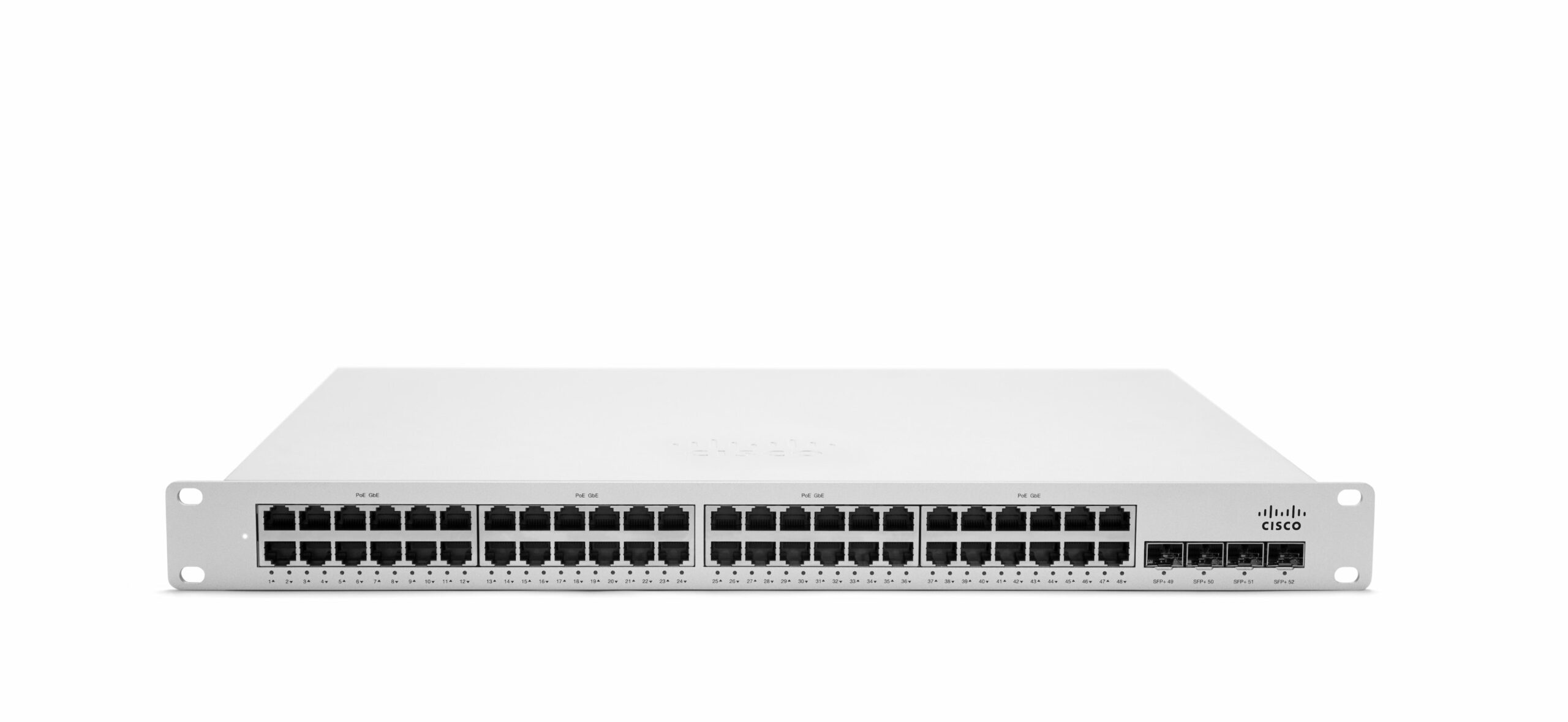
Cisco Meraki MS Series switches offer everything from copper edge switches to 100GB fiber aggregation switches with powerful OSFP dynamic routing. Cisco Meraki offers a cloud-first, subscription-based model focused on simplicity, ease of use, and rapid deployment. Meraki’s licensing is subscription-based and tied directly to cloud access, requiring an active license for operation, support, and dashboard availability.
Pros:
Plug-and-play configuration (friendly warning messages saves bad config)
Extremely easy to deploy, saving loads of time
Very scalable—simple to add on
Allows a network admin without highly specialized knowledge to configure VPN mesh
Manageable from any device anywhere
Easily stackable (it’s all done for you in the Meraki Dashboard)
Most monitoring software is designed primarily for Meraki
Manages automation and mass changes with ease
Works with any firewall
Reports traffic type and bandwidth usage
Has alert capabilities
Includes an address from your admin VLAN’s DHCP scope, which you keep
Eases service desk training requirements
Reduces network troubleshooting time
Simplifies management of multiple switch ports at once
Empowers network issue solutions without immediate escalation
Has incredible customer service
Cloud managed networking and cloud management with centralized control and automated updates
Meraki devices are central to Cisco’s cloud-managed networking approach
Dashboard allows application of configuration templates across thousands of sites
Architecture allows for remote management, reducing troubleshooting time and travel for IT teams
Dashboard includes integrated packet captures, event logs, historical connectivity charts, and location analytics
Architecture simplifies complex tasks such as VLAN provisioning, policy assignment, and network segmentation
Template-driven framework ensures consistent policy application across all devices
Cloud-managed firewalls, content filters, and endpoint management tools provide a comprehensive security solution
Security center highlights threats, blocks risky traffic, and provides simplified logs for administrators
Centralized dashboard allows administrators to manage security policies anywhere, even from mobile devices
Integrates its security features directly into its ecosystem
Robust security and advanced control features for enterprise environments
Monitoring capabilities include real-time visibility and automated alerts
Simplified deployment and reduced need for manual configuration or requiring manual intervention
Accessible for non expert users
Effective troubleshooting tools
Support for Wi-Fi standards and high performance in high-density environments
Approach to simplifying policy enforcement and security policies
Well-suited for scalable networks and growing enterprises
Cons:
Can’t configure everything down to a very granular level
Requires support licensing
Limiting when coming from command-line options
Not all advanced features are available
Can be burdensome with internet issues
Delay in reporting and debugging
Losing a Meraki license can lead to device shutdown after a grace period, making long-term budgeting critical
Subscription-based model can become expensive for large-scale deployments, necessitating careful long-term budgeting considerations
After scanning this Aruba vs. Meraki switch comparison guide of pros and cons, it becomes clear that Aruba is a worthy opponent. However, Meraki manages to be light years ahead in several key sectors. Meraki’s cloud-managed approach is particularly well-suited for scalable networks and excels in high density and high device density enterprise environments, ensuring reliable performance as your organization grows.
Meraki switches optimize performance while maintaining the highest levels of security. Cisco Meraki integrates its security features directly into its ecosystem, allowing administrators to manage security policies from a centralized dashboard. This robust security approach includes cloud-managed firewalls, content filters, and endpoint management tools, providing a comprehensive security solution. Meraki’s security center highlights threats, blocks risky traffic, and provides simplified logs for administrators. The centralized dashboard enables administrators to manage security policies anywhere, even from mobile devices, simplifying policy enforcement and ensuring consistent policy application across all devices through Meraki’s architecture and template-driven framework. Automated updates streamline security maintenance and reduce manual intervention, keeping network devices up to date and secure. Protecting business assets is vital, so Cisco Meraki employs several security features to lock down ports and communications across the network.
802.1x port-based network access control
MAC-based authentication
Port-by-port lock down access
Guest VLN
Rogue DHCP server detection
Port isolation
When you purchase Meraki switches from Stratus, you gain access to service features you can—but don’t want to—live without.
Ensure you get optimal network performance when you consult with our specialists. Deploy your network with minimal interruption when you hire our project management team as your lieutenant. Meraki’s advanced monitoring capabilities and effective troubleshooting tools provide real-time visibility, automated alerts, and systematic issue resolution to help maintain network performance and operational efficiency. Receive ongoing network monitoring should you choose to delegate that task to our Certified Cisco engineers.
In today’s increasingly complex enterprise environments, network automation is no longer a luxury—it’s a necessity. Both Cisco Meraki and Aruba Networks recognize this, offering advanced automation capabilities designed to simplify network management, boost operational efficiency, and enhance security across your entire network.
Cisco Meraki’s cloud managed platform stands out for its intuitive centralized dashboard, which empowers IT teams to automate configuration, monitoring, and troubleshooting tasks across all Meraki switches and devices. With Meraki, you can deploy configuration templates, automate mass changes, and leverage AI-driven optimization to proactively monitor and adjust network performance—minimizing manual intervention and reducing the risk of human error. This centralized control is especially valuable for organizations managing distributed sites or multi site deployments, as it streamlines device management and policy enforcement from a single pane of glass.
Aruba Networks offers similar strengths through Aruba Central, its robust cloud-based management solution. Aruba Central provides centralized management for switches, wireless networks, and access points, delivering AI-driven insights that help IT teams identify and resolve issues before they impact users. Automation features in Aruba Central enable rapid deployment, automated provisioning, and real-time monitoring, making it easier to maintain high availability and performance even in dense environments or large networks.
When you’re ready to engage your enterprise network’s warp drive, shop for Meraki switches from Stratus Information Systems.
If you’re not quite ready to make that commitment, here are your alternative actions:
View our Cisco Meraki Comparison Guides with product charts, FAQs, and more.
Read Cisco Meraki news and resources.
Request a free demo of Meraki installation and configuration.
Get a customized quote for Meraki switches.