“End of sale” and “end of support” are not the same thing, and only one of them is a formal Cisco milestone. End of Sale (EOS) is the date Cisco stops selling a product. “End of support” is a general term, not a distinct Cisco milestone. Cisco’s formal final support milestone is the Last Date of Support (LDOS), after which support entitled by an active service contract is no longer available. Between those two dates, a product under an active contract keeps a defined set of support that steps down over time on a schedule that starts from the End of Sale date. Reading only the headline date on an end-of-life bulletin is how teams either act years too early or get caught after the support they were counting on has already stepped down.
If you want the full planning picture, what is reaching its dates across your network and how to sequence a refresh, start with the Cisco End-of-Support 2026 hub. This page explains the milestones so you can read your specific bulletin correctly.
End of Sale is when Cisco stops selling a product. “End of support” is the general term people use for when Cisco stops supporting it, which in Cisco’s formal terms is the Last Date of Support. The two are separate events, and for many products they fall years apart. That gap is the whole reason the distinction matters: a product can be well past End of Sale and still supported under an active service contract, or still running in your rack long after its support has ended.
The important shift in thinking: End of Sale is not the day your gear becomes unsupported. It is the day the clock starts on a series of support windows that count down from that date.
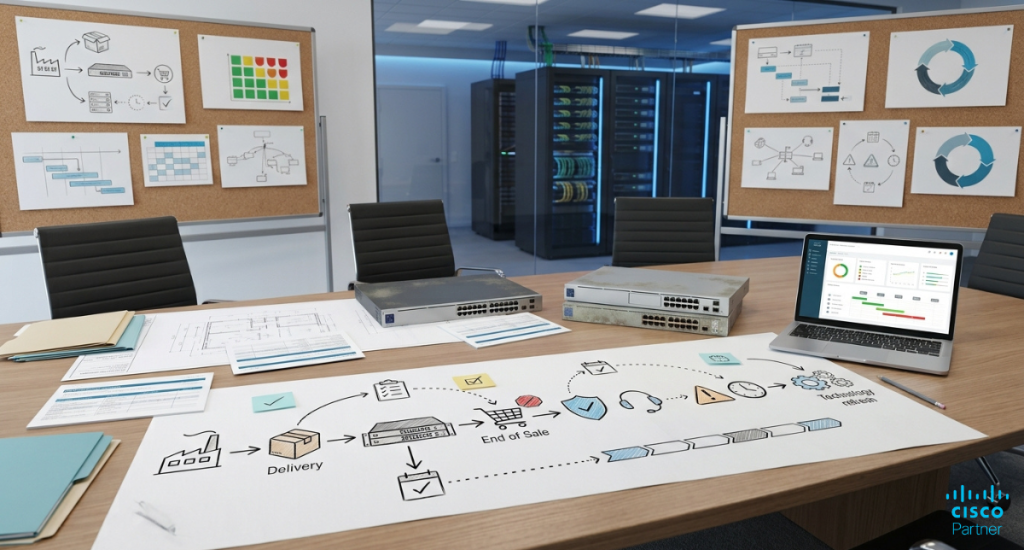
Cisco’s general End-of-Life Policy defines a small set of core milestones:
| Core milestone | What it means |
|---|---|
| EOL Notification Date | Cisco publicly announces the End of Sale and the end-of-life schedule. Notice of End of Sale is typically given around six months ahead. |
| End of Sale (EOS) | The last date to order the product through Cisco. After this, it is no longer sold. |
| Last Customer Ship Date | The last date units actually ship. For hardware, generally about three months after the EOS date. |
| Last Date of Support (LDOS) | The last date to receive support entitled by an active service contract. After LDOS, that support is no longer available. |
Individual product bulletins commonly list additional milestones on top of these, such as End of Routine Failure Analysis, End of Software Maintenance, End of Vulnerability/Security Support, End of New Service Attachment, and End of Service Contract Renewal. These are common but not universal. Not every bulletin includes all of them, so always read the bulletin for your exact part number.
Two notes that change how you read a bulletin. First, Meraki products follow a separate Meraki End-of-Life Policy, not this general one. If you are planning Meraki gear, use that policy. Second, the dates that actually drive your risk usually are not LDOS. They are the support windows that count down from End of Sale, below.
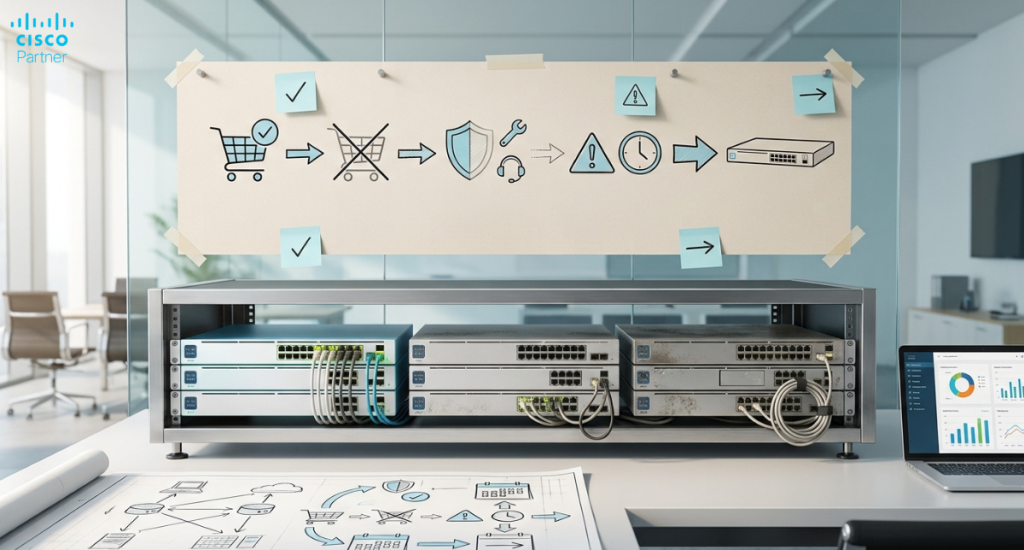
For a product under an active support contract, End of Sale starts a set of support windows that step down over time. The timelines below are Cisco’s general policy baselines. The specifics for any given product are governed by its bulletin and by your service contract, so treat these as the shape of the schedule rather than guaranteed dates for your unit.
| Support (general baseline, measured from EOS) | Typical window |
|---|---|
| Routine failure analysis (hardware) | About 1 year from EOS |
| Bug fixes and critical-bug patches via TAC | About 1 year from EOS, then, where available, roughly 2 more years for OS software and 1 more year for application software, and you may need to move to a newer software release to receive them |
| TAC support | OS software about 3 years from software EOS, application software about 2 years, hardware about 5 years. The final OS release on the hardware is generally coterminous with the hardware’s LDOS |
| Replacement parts (RMA) | About 5 years from EOS |
The practical read: your contract keeps working after End of Sale, but what it covers narrows in stages. Bug and patch coverage narrows earlier than hardware TAC or replacement, and it often comes with a condition: you may need to be running a still-supported software release. That is the milestone many teams miss, because it is not the headline date.
On security specifically, vulnerability-fix availability after End of Sale is governed by the applicable product bulletin. Where a bulletin lists an End of Vulnerability/Security Support date, that date is a specific cutoff for planned or scheduled remedies. After LDOS, Cisco’s Product Security Incident Response Team (PSIRT) may accept vulnerability reports but will not analyze, fix, disclose, or issue CVEs for newly reported vulnerabilities in the product, per Cisco’s Security Vulnerability Policy.
Yes, up to a point, and the rules for adding, renewing, and ending coverage are three separate things worth keeping straight:
So “I will just buy support later if something breaks” only holds within these windows. Once a unit is past its attach window, or heading past LDOS, that option narrows or closes.
LDOS is Cisco’s formal final support milestone. At LDOS, standard contractual support ends. TAC cases, contract renewal, and hardware RMA under those entitlements are no longer available. One qualification worth knowing: separately purchased extended support may be available for certain eligible hardware and limited application software, though not universally. Anchor your planning on “standard entitled support ends” rather than “everything instantly disappears.”
Practically, LDOS is not the date you plan toward. It is the date your plan should already be finished. If a platform is still in production on its LDOS date, you have likely been carrying narrowing support and rising security exposure for a while already.
“End of Sale means I have to stop using it.” No. It means you cannot buy it new from Cisco. Deployed units keep running and, under contract, keep a stepped-down set of support for years.
“It still works, so there is no risk.” Functioning is not the same as supported. The risk is not that it stops one morning. It is that as it ages past its support windows, fix and patch availability narrows and security exposure grows, with increasingly limited options for repair or replacement when it eventually fails.
“I can just buy support later if something breaks.” Only within the attach and renewal windows, and never past LDOS for standard support. Wait too long and the option is gone.
A mid-sized company with a dozen sites gets an end-of-life bulletin for a switch platform in their core. The bulletin lists several dates. The instinct is to find the last one, LDOS, see it is a few years out, and relax.
That is the trap. LDOS is the ceiling, not the trigger. The dates that should drive their plan are the support windows counting down from End of Sale, particularly the point where bug and patch coverage narrows and starts requiring a supported software release. They back plan from that, not from LDOS: estimate procurement and a phased cutover across twelve sites honestly, and land the refresh before support narrows, on their own budget cycle. And because this is a hypothetical, note the real-world caveat: the exact dates live in that specific bulletin, and if it were Meraki, under a different policy entirely.
Once you know the dates, each affected platform gets one of three responses. Replace when it is core, security-exposed, or its support has already stepped down materially. Extend when a successor is planned and coverage is still attachable within the windows above, legitimate runway with a hard limit at LDOS. Accept the risk when the gear is isolated, non-critical, or scheduled for decommission. The full framework, when each fits and how to sequence it, is on the Cisco End-of-Support 2026 hub.
Want the milestone definitions and a refresh-planning worksheet in one place? Get the Cisco lifecycle planning guides.
What is the difference between end of sale and end of support for Cisco equipment? End of Sale is the date Cisco stops selling a product. “End of support” is a general term for when support ends, which formally is Cisco’s Last Date of Support (LDOS). They are separate milestones, often years apart. A product can be past End of Sale but still supported under contract, because the support entitled by that contract steps down over time starting from the End of Sale date.
Can I still use Cisco hardware after end of support? Yes, the hardware keeps running, but functioning is not the same as supported. Under an active contract you keep a stepped-down set of support after End of Sale, and after the Last Date of Support that entitled support ends. So the gear becomes a growing security and reliability risk even while it still works.
What happens on Cisco’s last day of support? The Last Date of Support (LDOS) is Cisco’s formal final support milestone. At LDOS, standard contractual support, meaning TAC cases, contract renewal, and hardware RMA under those entitlements, is no longer available, though separately purchased extended support may be available for certain eligible hardware and limited application software, but not universally.