Network teams use the words monitoring and management together so often that they start to sound interchangeable. They are related, though they are not the same job. Network monitoring is the visibility layer. It tracks device status, availability, performance, and events. Network management is the operating discipline that uses that visibility to keep the network stable, current, controlled, and recoverable.
That distinction becomes important the moment a business starts asking harder questions.
Who owns recurring faults?
Who approves changes?
Who reviews stale configurations?
Who schedules firmware work?
Who decides that the network is healthy enough for growth?
Monitoring can show symptoms and trends. Management decides what gets changed, what gets maintained, and how the environment is kept from drifting into disorder.
A business can buy network monitoring tools and still have weak network operations. A business can also have disciplined processes and still struggle if visibility is poor. The stronger model combines both, with clear ownership of each.
The shortest useful definition is this: network monitoring collects and presents network health data. That usually includes uptime, interface utilization, latency, packet loss, tunnel status, wireless health, hardware alerts, and event notifications when devices or links change state. Monitoring platforms exist to shorten detection time and give the support team a usable picture of current conditions.
That visibility matters because modern networks move too quickly for manual checks to be enough. A branch circuit can flap for ten minutes and recover before anyone notices. A wireless problem can affect one floor while the rest of the site looks fine. A VPN issue can appear only under load. Network performance monitoring helps expose those patterns by collecting metrics over time instead of relying on user reports alone.
Good monitoring does one more thing that often gets overlooked. It establishes baselines. Without baselines, every spike looks suspicious, and every quiet period looks normal. With baselines, the team can tell the difference between routine behavior and the early signs of a real fault. That is where alert quality improves.
Monitoring still has a hard limit. It can tell the team what changed, where it changed, and often when it started. It does not decide how the environment should be corrected, documented, maintained, or governed afterward.
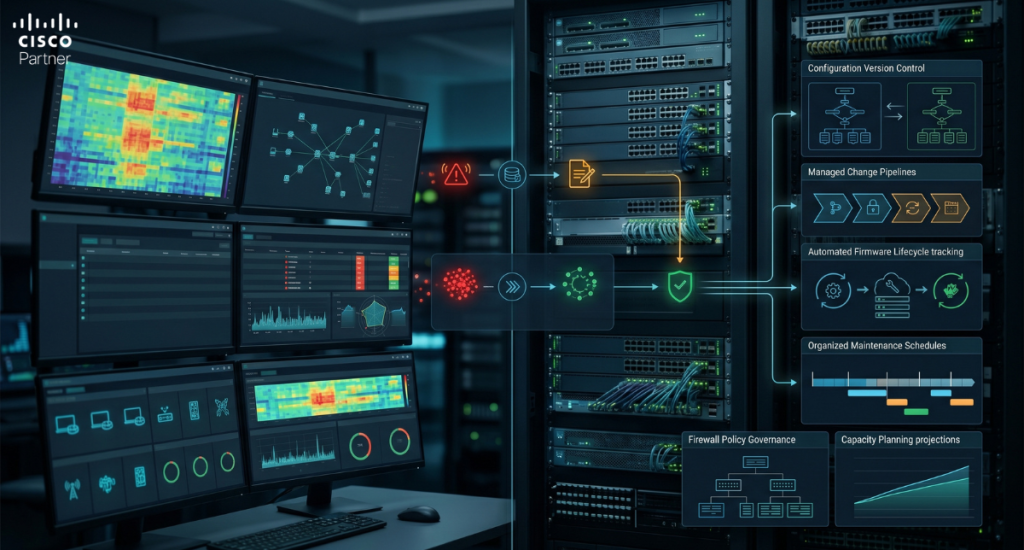
Network management includes monitoring, though it extends far beyond that. Network management includes configuring, monitoring, and managing network performance, which is a broader scope than observation alone. In day-to-day operations, that scope usually includes troubleshooting, configuration management, maintenance planning, change control, firmware and software upkeep, backup and restore, policy review, and capacity planning.
This is the part of the work that keeps a network usable over time. An alert is raised. Management decides who takes ownership. A recurring wireless complaint appears. Management determines if the cause is RF, density, configuration drift, or upstream congestion. A firewall exception is added during an urgent change. Management decides if that exception should remain, be narrowed, or be removed later. Monitoring helps expose the issue. Management keeps the issue from becoming permanent debt.
That is why businesses often misjudge their support maturity. They see dashboards, reports, and alerts, and assume the network is being managed well. In reality, they may only be watching it. If repeated faults persist, maintenance windows keep slipping, or if no one is cleaning up drift, the network is visible but not well managed.
The gap shows up most clearly in routine work. A monitoring platform can show that one site has unstable uplinks every Tuesday morning. Management asks why, checks the carrier history, reviews local changes, and decides whether the issue belongs in escalation, redesign, or capacity planning. A monitoring tool can report frequent access-point retries in one area. Management decides if the answer is channel adjustment, client review, AP placement, or deeper wireless analysis.
This is also where configuration management and change control enter the conversation. Monitoring rarely fixes the network state that created the problem. Management does that through standards, approvals, rollback planning, and documentation. If those disciplines are weak, monitoring keeps discovering the same categories of trouble.
Another difference is time horizon. Monitoring is immediate and short-range by design. It is concerned with present conditions and recent trends. Management has to work across the full lifecycle of the network. It deals with current faults, planned changes, maintenance calendars, support burden, and future capacity. That longer view is what prevents small operational compromises from turning into expensive outages later.
| Area | Network Monitoring | Network Management |
| Primary purpose | Detect conditions and expose network health | Operate, maintain, and improve the network |
| Main outputs | Alerts, metrics, dashboards, trend data | Decisions, changes, maintenance actions, standards, recovery plans |
| Core question | What is happening? | What should be done about it? |
| Typical activities | Telemetry collection, alerting, status visibility, reporting | Troubleshooting, configuration management, change control, maintenance, backup and restore, firmware planning |
| Time horizon | Current state and short-term trends | Day-to-day operations plus long-term stability |
| Success measure | Faster detection and clearer visibility | Fewer repeat issues, safer changes, cleaner operations, stronger recovery readiness |
| Can it stand alone? | Only in very limited environments | No, because management depends on visibility |
This distinction is consistent with the way current technical sources define the two functions.
The confusion usually starts with tools. Monitoring is easy to see because it produces dashboards, maps, reports, and alerts. Management work is less visible. It shows up in maintenance windows that go well, cleaner configurations, better documentation, fewer recurring incidents, and faster recovery when something does fail. That kind of work is essential, though it does not market itself as easily as a dashboard.
Procurement language adds to the problem. A proposal may promise monitoring and management in the same paragraph, while the actual scope stops at observation, notification, and light escalation. A business signs for operational control and gets event visibility instead. That mismatch is one of the main reasons support models disappoint.
There is also a staffing reason. In a small environment, one person may handle alerts, changes, maintenance, vendor tickets, and troubleshooting. Monitoring and management live with the same engineer, so the distinction feels academic. Once the network grows, it becomes practical very quickly. Visibility can still work while management starts slipping under the weight of accumulated operational work.
A network with solid monitoring and weak management often looks healthier than it is. The team sees link events, latency changes, and wireless trouble areas. Reports are available. Dashboards are current. Yet old configuration drift stays in place. Firmware work is postponed. Firewall exceptions accumulate. The same branch produces the same tickets. In that environment, the tools are fine. The operating discipline is not.
This is one reason recurring incidents matter so much. A single event does not prove weak management. A repeating pattern usually does. When the same categories of issues keep surfacing, the network is signaling that visibility exists, but corrective ownership is weak. Monitoring can keep proving the point. Management is what breaks the cycle.
The reverse problem is less common, though it still appears. A team may have good standards, careful change discipline, and strong maintenance habits, yet poor visibility still slows them down. They find out about issues from users first. They have incomplete baselines. They spend too much time confirming what the network is doing before they can start correcting it. The processes are mature. The telemetry layer is not.
That model can function for a while in a small, stable network. It becomes much harder to sustain in multi-site environments or in networks with heavier wireless dependency, branch traffic, VPN use, or cloud application reliance. Visibility stops being optional at that point. It becomes part of operating speed.
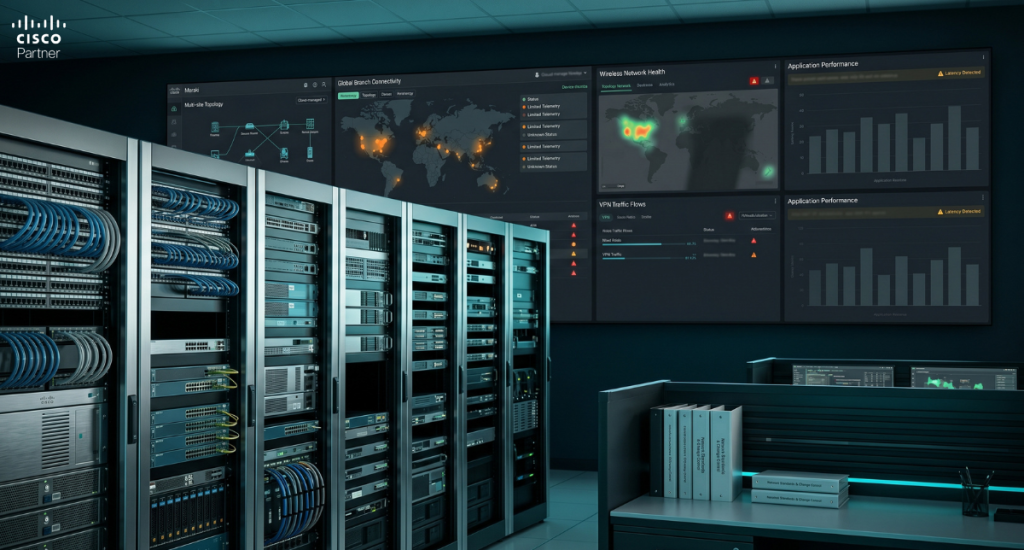
Cloud-managed platforms make the distinction easier to see because they centralize the visibility layer so clearly. In Cisco Meraki, for example, the dashboard provides organization-wide status, alerts, event visibility, and remote access to device settings across supported networks. That supports network monitoring directly by making distributed environments easier to observe from one place.
What it does not do is eliminate management work. Someone still has to define standards, approve changes, schedule maintenance, control permissions, review recurring faults, and decide what should be improved next. Centralized visibility helps. It does not create operational discipline on its own. That is why cloud-managed networking often works best when paired with clear ownership.
Most businesses need both, though not at the same level.
If the environment is small and stable, a monitoring gap may be the most obvious weakness. If the environment is multi-site, growing, or already carrying maintenance debt, management gaps usually matter more. That is where businesses start asking for stronger network management services rather than only better network monitoring tools.
A useful evaluation starts with a few blunt questions. Are alerts acted on consistently? Are recurring faults actually being eliminated? Are changes controlled well? Is maintenance planned or just postponed? Can the team explain the current operational state of the network without rebuilding the picture from scratch? Those answers reveal quickly which side is weaker.For organizations reviewing that gap now, the practical next step is not a debate over terminology. It is an operational review. For business networks that need better visibility, more control, or both, Stratus Information Systems can provide support for that and more.