Temperature, humidity, and air quality have a direct effect on what leaves the loading bay. A small temperature spike near a curing oven can change material properties. High humidity in a packaging zone can affect labels, adhesives, or powders. Poor air quality can damage sensitive electronics before they even ship. Modern plants run closer to their limits than ever, with tighter tolerances, lean inventories, and aggressive throughput targets. That pressure makes reliable environmental monitoring a core part of smart manufacturing, not a side project. When conditions drift, quality teams need to know fast. When they stay within range, operations leaders need proof they can show to auditors and customers.
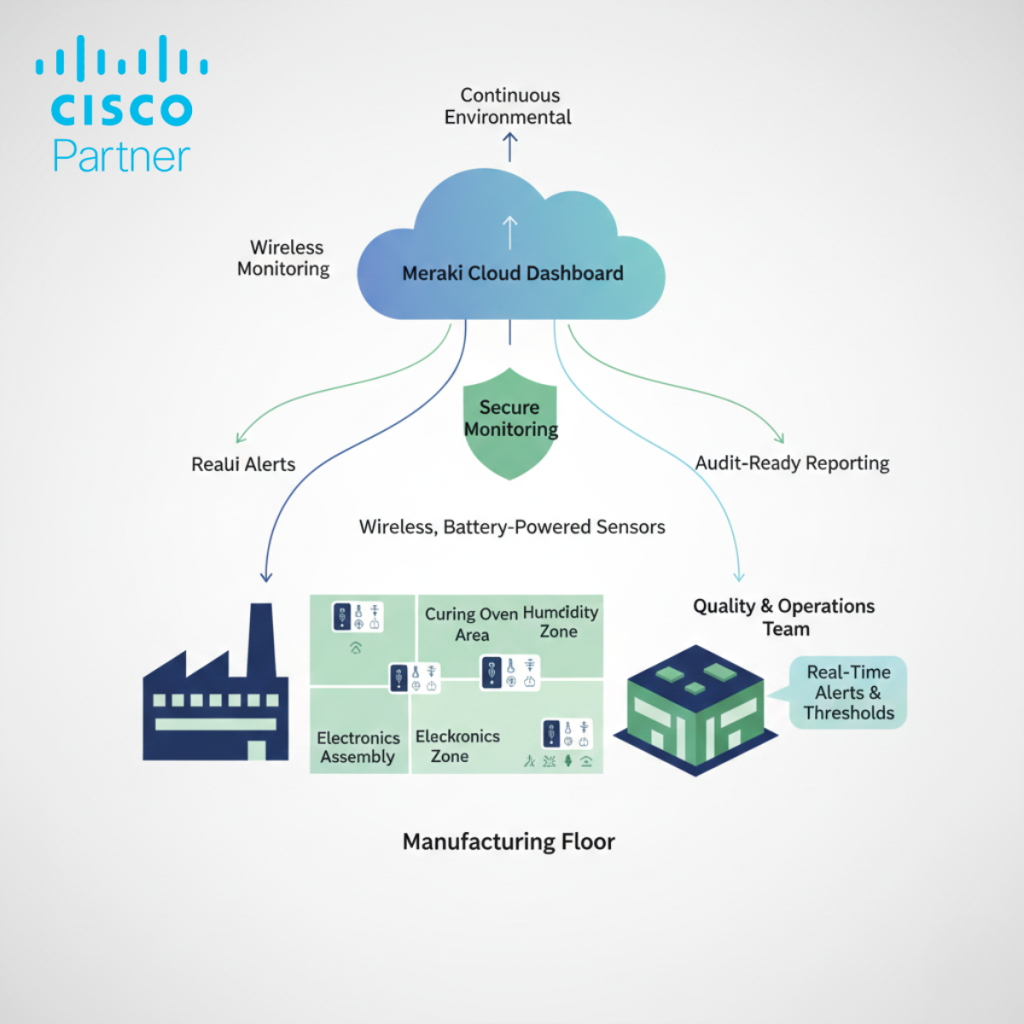
Cisco Meraki MT sensors give plants a practical way to watch these conditions continuously without building a complex telemetry stack. They provide wireless, battery-powered monitoring that feeds directly into the Meraki cloud. That model fits well with production line monitoring, where zones are spread across large floors and mezzanines. Engineering teams can define thresholds and receive real-time alerts before conditions turn into scrap or downtime. Temperature and humidity monitoring goes from spot checks to continuous coverage.
The Meraki MT range covers several environmental risks that matter on a factory floor. Instead of treating “sensors” as a generic category, it helps to line them up by function.
By mixing these roles across the plant, manufacturers can tailor environmental monitoring to each zone instead of applying a single generic profile everywhere.
In industrial IoT (IIoT) projects, the friction often appears in wiring and integration work. Adding sensors can mean pulling new cable, finding power, routing through noisy trays, and integrating with existing gateways. Meraki MT sensors are designed to sidestep much of that complexity. They communicate over Bluetooth Low Energy to nearby Meraki MR access points or MV cameras, which act as gateways. That means many plants can use their existing Meraki wireless or video infrastructure as the transport layer for environmental data.
Each device is a cloud-managed sensor. It ships pre-associated with the Meraki dashboard, so teams claim it, assign it to a network, and configure it centrally. Zero-touch provisioning reduces time on ladders and in tight spaces. Deployment teams can stage configuration in the dashboard before the hardware arrives on site. Operators then mount devices in the correct spots and power them up. Once connected to a nearby gateway, the sensors begin sending readings and real-time alerts into the cloud without extra protocol translation or local servers. For IIoT programs that already lean on Meraki network gear, that simplicity frees engineers to focus on thresholds and workflows instead of plumbing.
Environmental risk is not the same in every corner of a plant. Meraki MT sensors adapt well to that variety. In machining or CNC environments, MT10 units can sit near control cabinets or coolant reservoirs to ensure temperatures stay within safe ranges. In coating or printing areas, MT14 sensors can monitor air quality where solvents or fine particulates are present, giving safety and facilities teams continuous visibility into exposure risk. Storage zones for adhesives, resins, or temperature-sensitive intermediates are natural candidates for combined temperature and humidity coverage.
Around production lines, MT20 contact sensors fit doors, machine panels, and cages. They help correlate access with maintenance activity or fault patterns. Pairing MT20 events with work order systems tightens the link between physical access and documented jobs. In shipping and receiving, sensors can track when dock doors sit open for extended periods, which ties back to both climate control and security. Across all these spaces, Meraki MT sensors support smart manufacturing strategies by exposing conditions that often stay invisible until a failure or complaint arrives.
Alert noise can be as harmful as alert silence. Meraki gives teams enough control to keep both in check. For each sensor, engineers define thresholds for temperature, humidity, and air quality metrics in the dashboard. Those thresholds can vary by area. A clean room needs tighter control than a warehouse. A drying oven might tolerate higher temperatures but narrow humidity ranges. Configuration profiles capture these differences, so each group of sensors enforces the correct expectations for its zone.
Once thresholds are in place, teams define how real-time alerts should behave. Email is common for lower-priority events. SMS or mobile push notifications may be reserved for urgent issues, such as a rapid temperature rise near critical equipment. Webhook support lets plants integrate alerts with ticketing platforms, messaging tools, or incident systems. Events from Meraki MT sensors can complement meraki location analytics coming from Wi-Fi clients, so operations teams see movement and conditions together. A structured escalation path built into the dashboard replaces ad hoc calls and chats when environmental conditions drift outside safe ranges.
Alarms alone do not correct an issue. The value comes when teams tie alerts to clear responses. Meraki MT sensors serve as the detection layer in that chain. For instance, if humidity exceeds a set point in a packaging cell, an alert can be sent to local supervisors, who then activate dehumidifiers or adjust HVAC settings. In more advanced setups, webhooks can trigger automation through external platforms that interface with building management systems. The critical point is that teams see the event quickly enough to intervene before quality limits are exceeded.
Cabinet and panel monitoring is another good example. An MT20 contact sensor wired to a chemical storage door can send a real-time alert when the door is opened outside approved hours. Security or safety teams can verify the event in seconds and respond appropriately. On the line, an MT30 button can let operators flag an emerging condition that sensors alone might not capture, such as condensation forming on a surface or unusual smells from a process. Combining automated and human-triggered signals creates a richer picture of environmental monitoring and shortens the path from detection to mitigation.
Environmental data gains value over time. Every reading from an MT sensor is stored and made available for review in the Meraki dashboard. That history supports compliance reviews and internal audits. Food processors, pharmaceutical plants, and medical device manufacturers often face strict requirements around temperature, humidity, and air quality for both in-process and stored materials. Having continuous logs ready for export makes those discussions straightforward instead of stressful.
Beyond audits, the same data helps with process tuning. Engineers can correlate temperature or humidity trends with scrap rates, yield variation, or unexpected stoppages. Facilities teams can evaluate how HVAC changes show up in sensor readings across different areas. Smart spaces within a plant, such as controlled labs or prototype areas, benefit from historical analytics that highlight how often they sit at the limit of their environmental ranges. Meraki MT sensors keep that evidence accessible in one place, which supports both short-term investigations and longer-term improvements in production line monitoring.
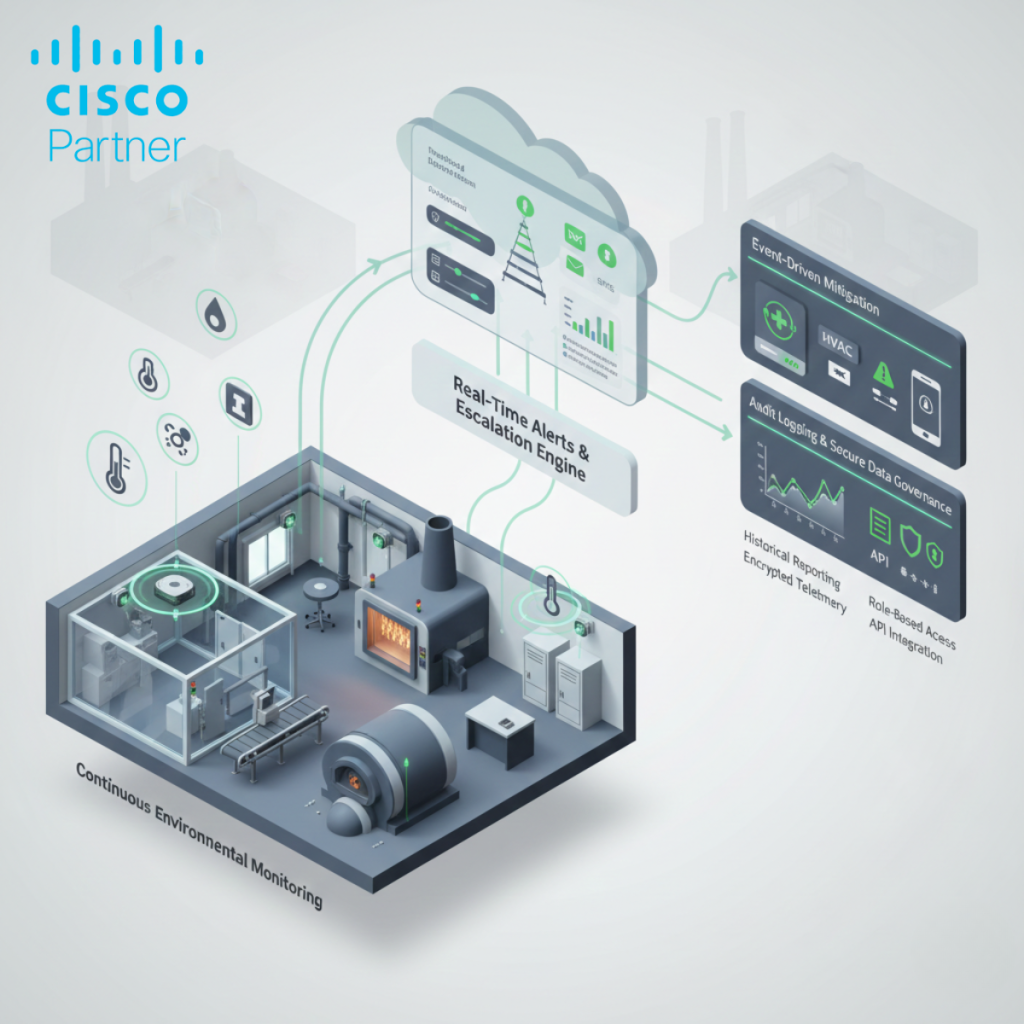
Meraki MT sensors rely on the Meraki cloud for configuration, visibility, and alert distribution. That cloud-first model simplifies management by centralizing policies and dashboards. For manufacturing, this means a plant with multiple buildings or even multiple sites can treat environmental monitoring as a single system rather than a collection of standalone loggers. Engineers work from one console to view live data, adjust thresholds, and review history.
At the same time, the system is designed with resilience in mind. Sensors maintain their last known configuration if connectivity to the cloud is interrupted. Gateways buffer data and resume uploads when links return. Alerts can still trigger based on persisted thresholds. This combination of centralized monitoring and local continuity helps plants trust the telemetry even when network links are under maintenance or experiencing brief issues. The result is a cloud-managed sensor platform that fits into industrial network resilience strategies instead of competing with them.
One advantage of Meraki in manufacturing is that Meraki MT sensors, access points, cameras, and switches are managed on a single management plane. MT sensors appear alongside MR, MV, and MS devices in the centralized dashboard. That unified network monitoring model keeps teams from juggling separate portals for network health and environmental conditions. If a production cell shows a quality problem, teams can pull up client connectivity, video footage, and sensor readings from one place.
Role-based access helps align that visibility with responsibilities. Facilities staff might see only MT and MV devices. Network engineers may work across the full stack. Quality teams can have read access to environmental monitoring data without the ability to change configuration. This shared but segmented view reduces friction between groups. Decisions are based on the same data, even if each team focuses on different layers.
Factories care about more than convenience. Environmental data ties into safety and compliance, so integrity matters. Meraki MT sensors use secure onboarding, encrypted communication, and hardware-based authentication to reduce spoofing and tampering risk. Data flows through the same secure channels that govern other Meraki devices. That matters in sectors such as food, pharma, aerospace, and high-end electronics, where audit trails and data origin can face sharp scrutiny.
Policy controls in the dashboard let administrators define which networks and roles can access sensor data. Integration with identity systems keeps access aligned with employment changes and shifts in responsibility. Network automation frameworks can consume MT data through APIs while respecting these policies, giving plants a path to advanced analytics without compromising on governance. Smart manufacturing initiatives often fail when data becomes scattered and poorly controlled. A structured approach to secure data collection keeps environmental monitoring from falling into that trap.
Many production tools have tight environmental windows in which they perform reliably. Reflow ovens, laser systems, curing lines, and certain chemical processes can all react badly to uncontrolled heat or moisture. MT10 sensors placed near these assets provide early warning when conditions drift. Rather than waiting for alarms from the equipment itself, which may trigger only when limits are exceeded, teams can act when trends begin moving in the wrong direction.
During a heat wave, for instance, ambient temperatures near a panel may rise faster than building averages suggest. The MT10 records that change and sends real-time alerts when thresholds are crossed. Maintenance can adjust cooling, adjust fan speeds, or temporarily throttle production before damage occurs. Over time, reviewing temperature and humidity monitoring data around sensitive tools can also guide investments in insulation, airflow adjustments, or enclosure upgrades. Production line monitoring gains a preventative dimension instead of staying reactive.
Air quality is a worker safety and product quality concern at the same time. In areas where operators spend hours close to processes, poor ventilation or subtle contamination can lead to fatigue, headaches, or longer-term health issues. In electronics or precision manufacturing, airborne contaminants can damage components or ruin surface finishes. MT14 sensors give those concerns a measurable footing. They track air quality parameters and push alerts when levels move outside agreed ranges.
Facilities and EHS teams can use this air quality monitoring to verify HVAC performance, filter replacement cycles, and process adjustments. For example, if a new coating material causes higher particulate readings, that signal may prompt both process review and ventilation improvements. In larger manufacturing campuses, the same sensors contribute to campus analytics that compare conditions between buildings and zones. Management gains a clearer view of which areas need investment and which are already stable.
Not every risk is airborne. Physical access to certain spaces or assets must be monitored for safety and compliance reasons. MT20 contact sensors give plants a simple way to track when doors, cages, or panels are opened. When paired with Meraki MV cameras, each open event can be tied to visual context and time-of-day patterns. That combination helps during investigations and improves routine oversight of sensitive areas.
In hazardous materials storage, MT20 events can correlate with digital logs of who signed out which materials. In electrical rooms, frequent panel openings may reveal undocumented work or recurring issues that need root cause analysis. In high-security manufacturing, open events outside permitted windows can feed directly into security incident workflows. These signals become part of a broader environmental monitoring picture that includes both conditions and the human actions that can affect them.
Regulators and auditors often ask a simple question: “Can you show that conditions remained within required limits over this period?” Meraki MT sensors give manufacturers a clean way to answer. Every reading is timestamped and stored, ready for export or review in the dashboard. That history supports ISO quality systems, OSHA-related safety reviews, or sector-specific standards for food and pharma.
Instead of hunting through local chart recorders or manual logs, teams can pull reports that show environmental monitoring for chosen zones and time frames. For events such as a refrigeration failure or HVAC outage, the logs help prove how long conditions were out of range and what actions followed. That clarity reduces the friction and uncertainty that often accompany compliance audits. Meraki MT sensors turn environmental conditions into a first-class data source rather than scattered notes.
Many plants already run analytics stacks, MES platforms, or ERP systems that track production, downtime, and material flow. Meraki exposes MT sensor data via APIs so that environmental metrics can feed those same pipelines. This aligns environmental monitoring with broader industrial IoT strategies. Instead of living in isolation, temperature, humidity, and air quality data sit alongside OEE metrics, machine logs, and maintenance records.
Network automation scripts can also use API access to reconcile configuration and sensor data. For example, an integration might flag zones where thresholds do not match documented standards or where sensors have gone silent. Location-based analytics that track how often specific zones run close to their limits can influence equipment placement or building improvements. By treating MT data as a shared resource, plants avoid building redundant silos that are hard to maintain.
Operational leaders need fast answers, not raw data. Meraki dashboards can aggregate sensor readings into views tailored for plant managers, production heads, or facilities directors. At a glance, they can see which zones are stable, which sit near thresholds, and where recent alerts occurred. Combining this with status panels for switches, cameras, and access points gives a unified picture of both IT health and environmental conditions.
When incidents occur, this real-time view speeds decision-making. If a chiller fails in one building, leadership can see which production lines are at risk and how fast temperatures have shifted. During peak seasons, dashboards can show how close storage zones are to their ideal ranges, helping teams adjust loads or schedules. In larger campuses, higher-level campus analytics across multiple buildings highlight where investments in HVAC, airflow, or insulation will yield the most benefit.
A strong design starts with careful site planning. Not every wall or beam is a good mounting point, and not every zone needs the same density of sensors. Teams should map out airflow patterns, heat sources, and sensitive assets. MT10 units should sit where they reflect actual operating conditions, not next to drafts or unrelated heat sources. MT14 devices should avoid locations where air is stagnant or directly blasted by vents, to prevent skewed air quality readings.
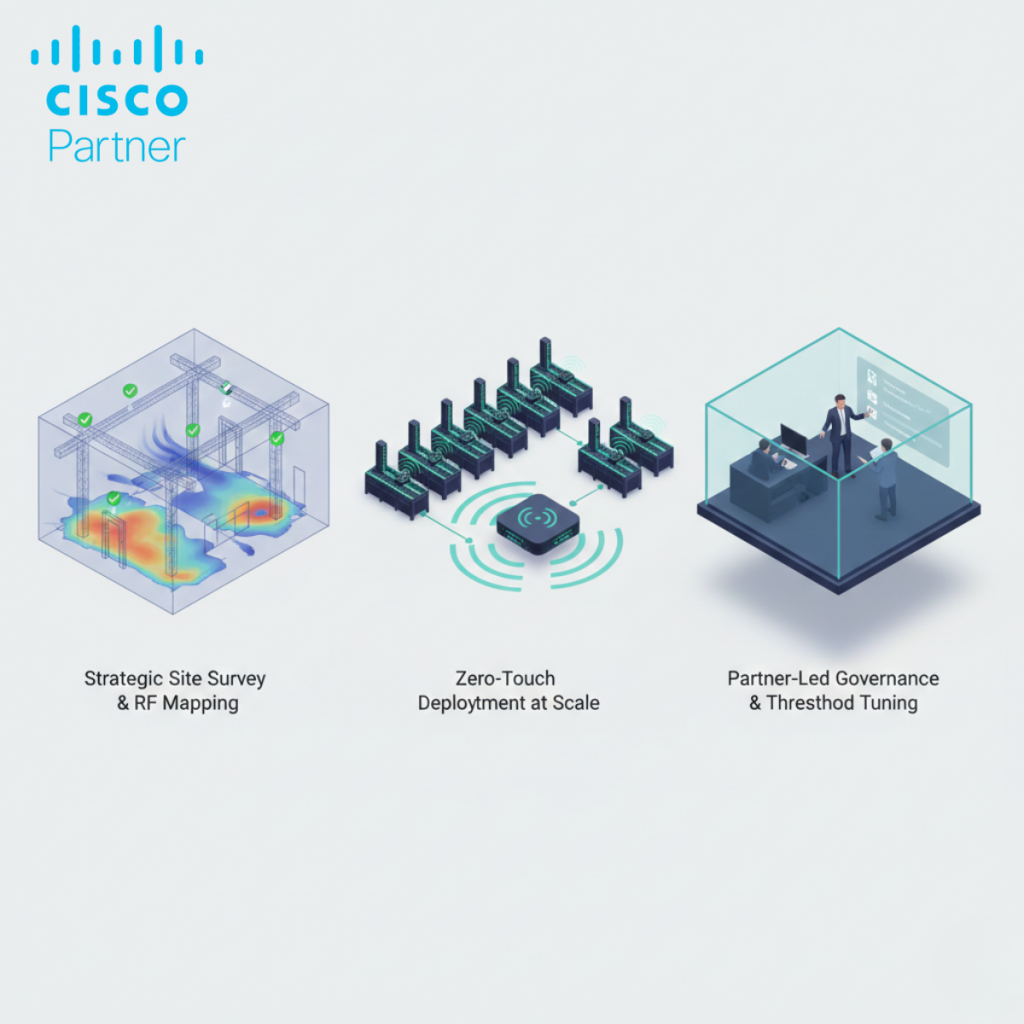
In heavy industrial areas, shielding and mechanical protection matter too. Sensors should stay out of direct impact zones, away from oil spray, and clear of moving parts. Yet they must remain close enough to the process to represent real risk. Because Meraki MT sensors rely on nearby MR or MV gateways, placement plans must also include signal coverage checks. A brief survey of Bluetooth reach in noisy RF environments can prevent frustrating gaps after install.
Deployment does not end when sensors go on the wall. Configuration work matters just as much. Teams should start with documented environmental limits from quality, safety, and equipment vendors. Those limits become the first set of thresholds in the Meraki dashboard. For example, a raw materials room might have a maximum humidity level, while a certain machine zone may have both minimum and maximum temperatures defined.
After the first weeks of operation, it makes sense to review alert frequency and adjust. If alerts arrive too often for harmless fluctuations, thresholds or hysteresis values may need tuning. If events arrive late, limits may be too wide or sampling intervals too long. Smart manufacturing strategies depend on alignment between real risks and alert logic. Production line monitoring should highlight the conditions that truly threaten quality, safety, or uptime without drowning teams in noise. Regular reviews of sensor configuration keep that balance healthy.
Many manufacturers prefer a partner to guide both the technical and process sides of MT deployment. Good outcomes require more than hardware knowledge. Someone has to align sensor placement with process-critical zones, configure alert flows that match existing escalation paths, and set up reporting that satisfies both engineering and compliance needs. Governance topics, such as who can change thresholds and how configuration changes are reviewed, must be addressed early.
Stratus Information Systems helps manufacturers deploy Meraki MT sensors for scalable, compliant environmental monitoring. That can include on-site surveys, sensor and gateway design, dashboard configuration, and integration with existing IT and OT systems. A partner-led approach speeds initial rollout and reduces the risk of blind spots or misaligned alert policies. With a clear governance model in place, plants can expand coverage across more lines and sites without losing control of configuration and data quality.
Environmental monitoring in manufacturing used to mean standalone loggers, manual checks, and scattered spreadsheets. Meraki MT sensors change that pattern. They provide continuous visibility into temperature, humidity, air quality, and key physical events, with real-time alerts when thresholds are crossed. Because they use existing Meraki network infrastructure and a single cloud dashboard, they fit cleanly into smart manufacturing programs that already depend on connected systems and shared data. Uptime, product quality, and worker safety benefit from the same sensor set.At the same time, the operational overhead stays low. Zero-touch deployment, centralized configuration, and clear reporting keep maintenance manageable even as the fleet grows. Integration with IIoT platforms and analytics tools turns raw readings into decisions about process improvements and investments. For plants that want a sharper view of conditions without building a custom telemetry stack, Meraki MT sensors offer a direct, practical path, turning environmental monitoring into a strength.