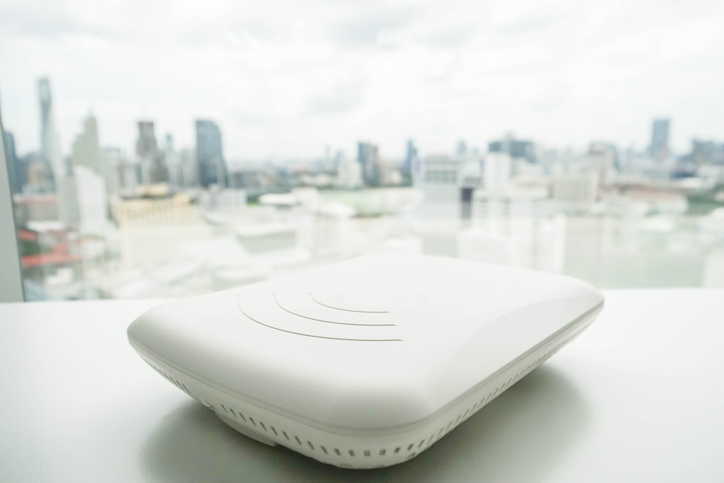
You already know what an access point is and why Cisco Meraki is the best brand in the biz, so we’ll skip a rehash of those topics to avoid wasting your time. What Stratus Information Systems will cover here are all the steps and details you need to know about how to add a Meraki access point and configure it to meet your network needs.
Cisco Meraki offers a range of access points, including the MR33—a quad-radio, cloud-managed 2×2:2 802.11ac Wave 2 access point with a maximum 1.3 Gbps aggregate frame rate and integrated Bluetooth Low Energy (BLE)—and the MR36, a Wi-Fi 6 cloud-managed wireless access point designed for high-density environments and improved performance. Both models are suitable for offices, schools, hospitals, and retail environments, supporting dual-band operation and next-generation deployments. Cisco Meraki access points are cloud-managed, allowing for simple management, scalability, and seamless integration across distributed networks. Their ability to provide AI-powered assurance, always-on threat protection, and full network visibility ensures optimized performance and security. Users consistently report great coverage, easy install, robust design, and high reliability, with the MR36 rated 4.7 out of 5 stars. While some users mention the price or cost is higher than some competitors, they agree the quality and features justify it. Many highlight the strong performance of Cisco Meraki access points in demanding business applications like voice and high-definition streaming video.
In total, this budget-friendly “plug-and-play” solution enables wireless network access via projected signal without compromising WiFi speed—and it only takes a minute or two of your time to do it.
There are multiple ways to add a Meraki wireless access point to a network, but this is one of the easiest:
Meraki APs utilize a plug-and-play deployment model, automatically downloading configurations from the cloud as soon as they are connected to the internet. This makes the install process fast and user-friendly.
The access point is now added to your network and available for configuration.
All Meraki APs support automatic mesh networking, so if the wired connection is lost, the AP can automatically find and link to a nearby gateway AP to maintain connectivity.
Tip: The same steps to add a Meraki access point can be performed within the Meraki dashboard. Cisco Meraki access points are designed for easy installation in various environments such as offices, schools, and hospitals.
Once an access point is added to your network, the network will automatically self-configure an SSID. It’s important to review this SSID to ensure the configuration is as you want it. The Wireless > Configure > Access Control page is used to configure per-SSID Access Control settings, and network access is defined on a per-SSID basis. If you want to make changes, they must be done before connecting the access point to the LAN.
To make any configuration changes to your access point, follow these four steps:
Meraki access points (APs) support Layer 3 roaming, allowing clients to maintain the same IP address while moving between APs in wireless networks. APs can be managed through the Meraki cloud dashboard, which simplifies configuration and monitoring.
The access point is now configured.
Tip: The same steps to add a Meraki access point can be performed within the Meraki dashboard.
The placement of your wireless access points (WAPs) is one of the most critical factors in building a fast, reliable, and secure wireless network. Cisco Meraki access points are engineered to deliver seamless wireless coverage, but their true potential is unlocked when they’re strategically positioned throughout your site.
When planning your wireless network, consider the physical environment—walls, floors, and even furniture can impact signal strength and coverage. The number of devices connecting to each access point, the types of applications in use (like video streaming or IoT devices), and your organization’s security requirements all play a role in determining optimal placement.
A professional site survey is highly recommended to map out coverage areas, identify potential sources of interference (such as other 2.4 GHz or 5 GHz devices), and ensure your access points are positioned for maximum performance. The Meraki dashboard offers powerful planning tools, including heat maps and predictive analytics, to help visualize and optimize your wireless network before and after deployment.
Cloud management makes it easy to configure, monitor, and adjust your WAPs remotely, ensuring your network remains secure and high-performing. Features like AES encryption, automatic firmware updates, and advanced security settings protect your wireless access from unauthorized users and evolving threats. Approved vendors like Cisco Meraki provide robust, enterprise-grade access points that support the latest IEEE standards (such as 802.11ac and 802.11ax), ensuring compatibility and future-proofing your investment.
Modern Meraki MR series access points leverage MU-MIMO and 2×2:2 MU-MIMO technology, allowing multiple devices to connect simultaneously without sacrificing speed or reliability. This is especially important in high-density environments like retail stores, hotels, and large offices, where dozens or even hundreds of clients may be online at once. With support for high-bandwidth applications, AirPlay, and IoT devices, Meraki access points deliver the flexibility and performance today’s businesses demand.
Installation is straightforward, and the Meraki dashboard’s intuitive interface makes ongoing management a breeze. Regular firmware updates and bug fixes are delivered automatically via the cloud, keeping your network secure and up-to-date with minimal effort. If a device needs maintenance or an upgrade, easy physical access to WAPs is recommended.
Custom splash pages can be configured to provide a branded, secure onboarding experience for end users, while advanced features like beamforming and store-and-forward functionality further enhance network reliability. Should you ever need to recover a deleted or forgotten password, the Meraki dashboard provides simple recovery options, ensuring you always have control.
Whether you’re expanding coverage to a new floor, supporting video streaming in conference rooms, or enabling secure wireless access for IoT devices, the right combination of Cisco Meraki access points, switches, and security appliances will deliver a comprehensive, cloud-managed networking solution. Input from users and stakeholders, combined with the analytics and planning tools in the Meraki dashboard, ensures your wireless network is tailored to your organization’s unique needs.
Imagine a wireless network that’s fast, reliable, and secure—one that grows with your business and is easy to manage from anywhere. That’s the power of Cisco Meraki and Stratus Information Systems. To learn more about optimizing your wireless access point placement or to get a free quote for your next project, contact our team or explore our Cisco Meraki solutions.
There are various reasons to remove an access point, such as being replaced by an upgraded Cisco Meraki wireless access point.
Here are the steps to remove a Meraki access point:
Your access point is now removed from your network.
Tip: The same steps to add a Meraki access point can be performed within the Meraki dashboard.
We get asked some questions over and over again, so here we answer FAQs about adding a Meraki access point.
From start to finish, plan on it taking between 10 and 30 minutes to set up a Cisco Meraki Access Point. The task is so quick because Meraki makes it so easy and intuitive with their plug-and-play devices.
Meraki access points have a built-in DHCP server. By default, Meraki access points may have DHCP enabled in NAT mode, assigning IP addresses to clients on a private 10.0.0.0/8 network. Administrators can also configure mandatory DHCP, which requires all client devices to use DHCP for IP assignment and blocks clients that do not request a DHCP address.
To configure your Meraki access point’s DHCP options:
While a DHCP configuration is recommended, you can configure a static IP address from the Meraki Dashboard.
In the dashboard:
It’s crucial to correctly calculate the number of access points you need in your environment. Getting it wrong can slow down employee work and be a big waste of money.
Here are the most important factors when calculating the number of needed access points (APs):
The installation of Meraki APs can be optimized by ensuring they are placed in locations that minimize interference and maximize coverage.
Note: Too many access points can cause radio frequency (RF) broadcasting and interference, leading to very poor WiFi performance. This is especially the case when access points aren’t placed properly.
As a premier Cisco Meraki reseller, we have all the products you covet. With centralized network management, automatic RF optimization, and dedicated security radio, MR access points are the most intuitive to add, configure, and manage.
Contact Stratus Information Systems to get access to all Cisco Meraki solutions.

Continue Reading...
Continue Reading...
Network & Connectivity
Monitoring & Security
Software & Support
Featured