Choosing the right firewall solution is crucial for protecting your business network and ensuring seamless connectivity. With an ever-growing array of threats and increasing demands for flexible network management, finding a solution that balances security, usability, and scalability is more important than ever. Cisco Meraki MX and Fortinet FortiGate are two of the most prominent names in the market, each offering distinct features and approaches to network security.
In this article, we will compare Meraki vs Fortinet. This comparison aims to provide a thorough understanding of both platforms, examining their key features, management capabilities, and deployment scenarios. We will offer a detailed comparison of Cisco Meraki MX and Fortinet FortiGate, highlighting key differences in features, performance, and value to help you make an informed decision.
The cybersecurity industry plays a crucial role in today’s digital landscape, as organizations across all sectors face an ever-expanding array of cyber threats. With the increasing complexity of network infrastructure and the growing sophistication of attacks, businesses must prioritize network security to safeguard their data, operations, and reputation.
As digital transformation accelerates, the need for advanced security features and comprehensive protection has never been greater. Cyber threats such as ransomware, phishing, and data breaches are constantly evolving, targeting vulnerabilities in both traditional and cloud-based environments. This makes it essential for businesses to adopt robust solutions that can adapt to new challenges and provide continuous protection.
Cisco Meraki and Fortinet stand out as leaders in the cybersecurity industry, offering innovative network security solutions designed to protect organizations from a wide range of threats. Cisco Meraki leverages cloud management to deliver centralized, user-friendly security services, making it easier for businesses to manage and secure their entire network from a single platform. Fortinet, on the other hand, is known for its powerful on-premises security appliances and flexible deployment options, catering to organizations with diverse operational needs.
Both Cisco Meraki and Fortinet provide essential security features such as intrusion detection, threat intelligence, and automated security updates, helping businesses stay ahead of emerging threats. Their solutions are trusted by enterprises worldwide to protect critical operations, ensure regulatory compliance, and support secure growth.
In a rapidly changing cybersecurity landscape, investing in proven network security solutions from industry leaders like Cisco Meraki and Fortinet is key to maintaining resilience and protecting your organization’s future.

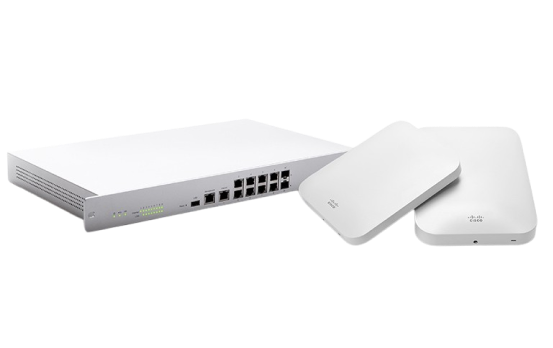
The Cisco Meraki MX series offers a fully cloud-managed firewall solution, integrating seamlessly into the broader Meraki ecosystem. As part of a comprehensive suite of Cisco products, Meraki MX is designed to deliver advanced network security and management capabilities. This approach eliminates the need for complex on-premises configurations, making deployment and management significantly easier.
Fortinet FortiGate is a hardware-centric firewall solution that offers robust security features and flexible deployment options. It is particularly well-suited for enterprise environments with complex security and scalability requirements, delivering enterprise-grade protection and management capabilities. While it provides advanced threat protection, its reliance on on-premises management can make it less accessible for organizations without dedicated IT resources.
Cisco Meraki MX is designed with simplicity and usability in mind. The Meraki Dashboard enables IT teams to manage all devices in one place, with intuitive interfaces and a user friendly interface, along with automation features like automatic firmware updates. This cloud-based management reduces the complexity of network administration, making it accessible even for smaller IT teams.
In contrast, Fortinet FortiGate relies heavily on on-premises management. While it offers granular control, the interface can be challenging to navigate, and updates require manual intervention. However, cloud management Fortinet provides centralized management features, greater scalability, and integrated security, offering a more flexible and enterprise-ready cloud management system compared to Meraki’s simplified approach. For businesses seeking efficiency and ease of use, Meraki MX offers a significant advantage.
Meraki’s cloud management can reduce operational overhead by simplifying administration, but it may introduce higher licensing costs and operational challenges in larger, more complex environments.
Both Meraki MX and FortiGate provide robust security capabilities, but Meraki’s integration with Cisco’s Talos Threat Intelligence offers a distinct edge. Meraki MX delivers:
These features are critical for preventing a data breach, helping organizations mitigate the risks and consequences of cyber threats.
FortiGate also delivers strong protection, but its traditional model often requires more frequent manual updates and configurations, increasing the risk of delays in addressing emerging threats. Both Meraki and FortiGate solutions can be tailored to meet different security requirements, allowing organizations to align their firewall deployment with their specific needs and management complexity.
The Meraki vs Fortinet debate often highlights scalability. Meraki MX excels in this area with its SD-WAN capabilities, which simplify the deployment of secure, scalable networks across multiple sites. As a result, Meraki offers scalable solutions that can support growing infrastructure demands. Additionally, Meraki’s dashboard enables quick and easy addition of new devices, streamlining deployment and zero-touch provisioning—especially valuable for large-scale environments. Businesses adopting hybrid or remote work models will find Meraki’s cloud-first approach particularly advantageous.
FortiGate, while scalable, is more hardware-dependent. Expanding a FortiGate deployment often requires significant investment in additional appliances, making it less flexible for rapidly growing organizations, especially large enterprises with complex network needs.
Cisco Meraki MX’s licensing model is straightforward, bundling hardware, software, and support into a single subscription. This predictability helps businesses manage costs effectively while ensuring they have access to the latest features and updates. Predictable licensing fees make it easier for organizations to plan their budget and manage the total cost of ownership over time.
Fortinet FortiGate, on the other hand, uses a tiered licensing structure that can become complex and costly. Businesses may need to purchase separate licenses for additional features, creating challenges in budgeting and management. However, certain Fortinet models offer competitive pricing and cost-effective options, making them attractive for organizations seeking affordable solutions. Budget considerations and long-term financial planning are important factors when choosing between Meraki and Fortinet, as both licensing fees and total cost can significantly impact the overall value for your organization.
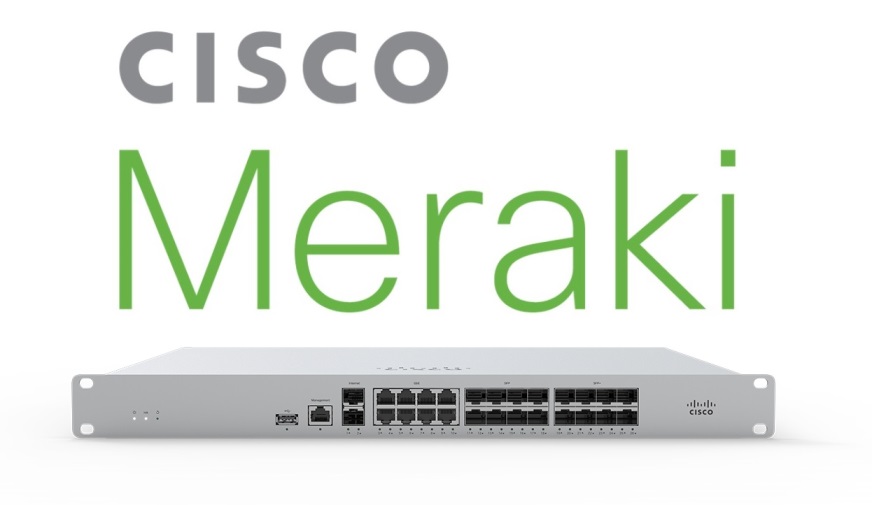
Cisco Meraki MX firewalls are designed for simplicity, scalability, and robust security, making them a top choice for organizations seeking cloud-managed network solutions. In addition to advanced features, Cisco Meraki is committed to supporting its customers with dedicated service, comprehensive resources, and ongoing assistance to ensure optimal network performance. This customer-centric approach sets Meraki apart in the “meraki vs fortinet” comparison, especially for enterprises prioritizing ease of management and reliable support.
The Meraki Dashboard centralizes network management, allowing IT teams to oversee multiple devices and locations from a single platform. This simplicity reduces the administrative burden and minimizes the risk of errors. By enabling centralized control, Meraki MX enhances operational efficiency by reducing downtime and streamlining network administration.
With built-in threat intelligence and advanced security features, Meraki MX protects against evolving cyber threats. The integration of adaptive policies and cloud-based updates ensures your network remains secure at all times.
Strong security features help prevent data breaches, which could otherwise result in lost revenue for businesses.
Meraki’s unified licensing model provides predictable costs, eliminating hidden fees and enabling businesses to plan their budgets with confidence. Stratus Informational Systems also offers excellent support for Cisco Meraki products, adding further value.
Businesses aiming to maximize ROI and optimize network investments benefit from Meraki’s predictable cost structure.
For small to mid-sized businesses planning to expand, Meraki MX offers unparalleled scalability. It is particularly well-suited for small businesses seeking scalable and easy-to-manage solutions, thanks to its intuitive cloud management and streamlined deployment. Its SD-WAN capabilities make it easy to add new locations without significant infrastructure changes.
Organizations adopting hybrid work environments benefit from Meraki MX’s seamless integration with cloud infrastructure, enabling employees to have secure remote access.
Additionally, Meraki MX empowers IT teams to monitor and optimize network traffic for remote and hybrid workers, ensuring consistent network performance and robust security.
Enterprises with geographically dispersed networks can leverage Meraki MX’s centralized management to maintain consistent security and performance across all locations. This centralized approach also helps ensure high network performance is maintained across all sites.
When comparing Fortinet vs Cisco Meraki firewall solutions, it’s clear that Cisco Meraki MX offers a superior solution for businesses seeking simplicity, scalability, and robust security. The cloud-managed approach of Meraki MX not only reduces the complexity of network management but also ensures that businesses are prepared for future growth and challenges.
While Fortinet FortiGate provides solid security features, its hardware-focused model and complex licensing structure make it less ideal for organizations prioritizing efficiency and flexibility. Cisco Meraki MX stands out as the ideal choice for businesses looking for a future-proof firewall solution.
Ultimately, the right choice between Meraki and Fortinet depends on the specific business needs and operational requirements of your organization.
Ready to revolutionize your network security? to learn more about Cisco Meraki MX and discover the perfect solution for your business needs. Our experts are here to guide you every step of the way.